All case studies

Case study 03  Deep dive

Claims Adjuster Copilot

Designing a human-in-the-loop claims experience where AI prepares recommendations, but a licensed adjuster reviews, edits, escalates and approves every consequential decision.

Concept / POC  Regulated AI  Human-in-the-loop

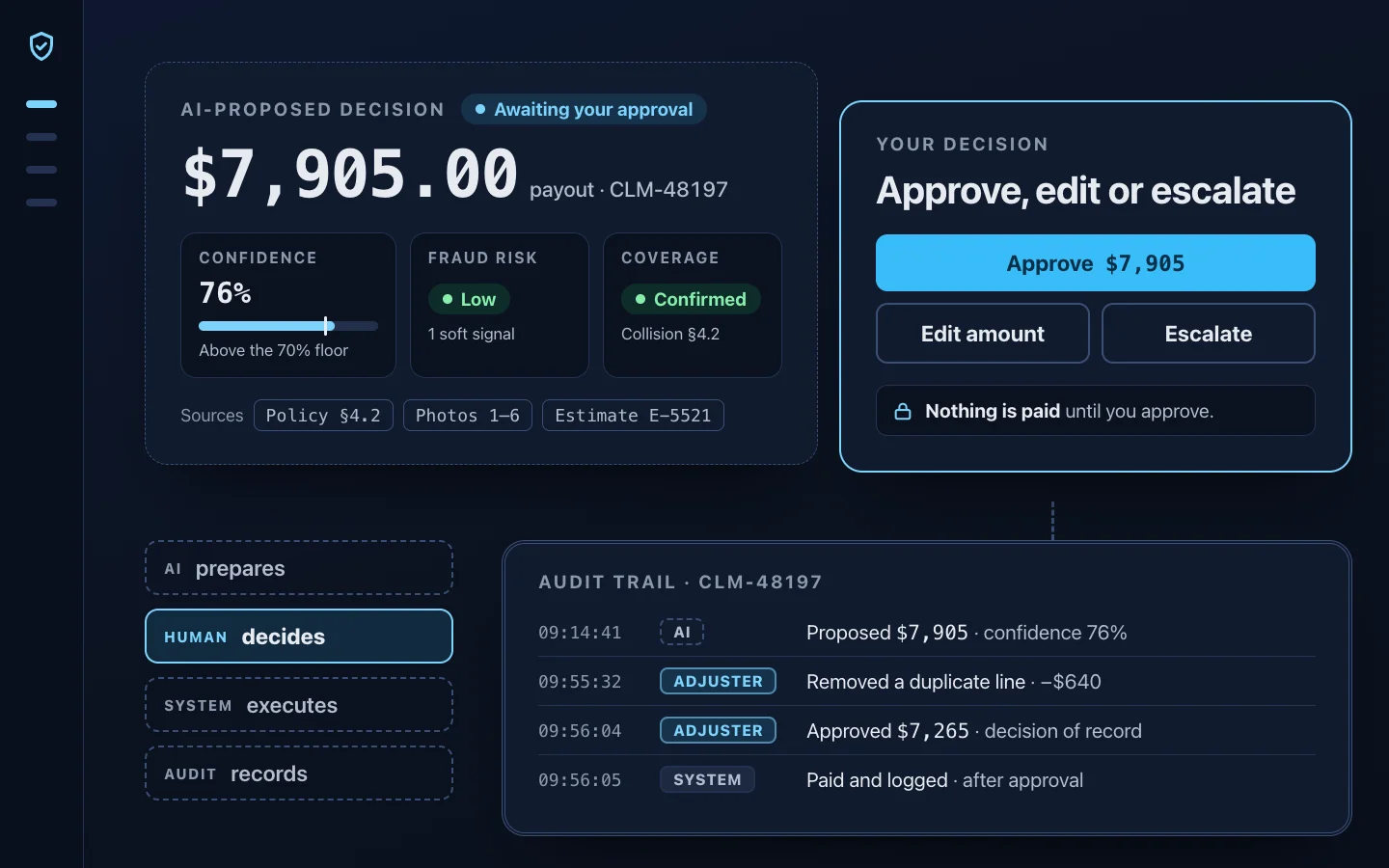
The AI-proposed decision, the human decision and the audit record: a $7,905 payout recommendation at 76% confidence, above an illustrative 70% floor, with fraud risk low, coverage confirmed and three cited sources; the adjuster’s choice to approve, edit the amount or escalate, with nothing paid until they approve; the motif AI prepares, human decides, system executes, audit records; and an audit trail where the adjuster removed a duplicate line, approved $7,265 and the system then paid and logged it
Role
Product / UX Design
Users
Claims adjusters, senior adjusters / SIU, compliance reviewers
Domain
Insurance claims
Scope
AI-assisted triage, recommendation review, escalation and audit
Status
Concept / working prototype

00  At a glance

The case in six lines

Product
AI-assisted claims decision workflow
Users
Claims adjusters, senior adjusters / SIU, compliance reviewers
My contribution
Product strategy, AI UX pattern synthesis, interaction design, UI and prototype
Evidence
Insurance-domain experience + secondary HITL / AI UX research
Status
Self-initiated concept / working prototype
Validation
Not tested with claims adjusters

01  The problem

Claims teams need speed without giving up accountability.

Adjusters work through a mix of straightforward claims, ambiguous cases, potential fraud, evidence gaps, payout decisions and exceptions. AI can help prepare a recommendation, but claims decisions carry financial, regulatory and customer consequences.

A claims desk handles
Straightforward claims
Ambiguous cases
Potential fraud
Evidence gaps
Payout decisions
Exceptions

The design problem is not simply: Can AI calculate a recommendation?

It isHow does a human understand, challenge, change and ultimately own that recommendation before anything happens?

Why this is high-stakes

A mistake here moves real money

  • Financial

    A payout moves real money.

  • Regulatory

    Claims decisions need to be explainable, with a record of who decided and why.

  • Customer

    A wrong amount or a delay lands on a policyholder.

The core design question

How much autonomy should an AI agent have when a mistake can move real money?

Thesis AI can prepare the decision. A human remains accountable for the outcome.

My role

A self-initiated concept, grounded in insurance experience

This was a self-initiated concept project created to explore human-in-the-loop interaction patterns in a regulated insurance workflow. I defined the product model, synthesized HITL and AI UX patterns, designed the end-to-end interaction flow, created the key screens and built a working prototype around review, edit, escalation and audit.

The insurance context draws on my broader enterprise insurance experience, but this claims product itself was not a client or production project.

What grounds it

  • My experience designing insurance and brokerage products
  • Secondary research on human-in-the-loop AI, approval gates, trust and transparency, escalation and auditability
  • Pattern synthesis: general AI UX patterns translated into a claims workflow

What I designed

  • The product model and the human-in-the-loop strategy
  • The end-to-end interaction flow
  • The key screens: queue, review, edit, rationale, escalation, audit
  • A working prototype with synthetic claim data

Self-initiated concept / POC. This project explores AI UX patterns in a claims context informed by my broader insurance experience. It was not a client deployment.

02  Research & principles

Translating HITL patterns into a claims workflow

This is not user research with adjusters. The grounding is domain experience and secondary research, and the work was translating general patterns into one claims decision.

  • Domain groundingMy prior experience designing insurance and brokerage products.
  • Secondary researchHuman-in-the-loop AI patterns, approval-gate models, trust and transparency guidance, escalation patterns, and auditability in regulated systems.
  • Pattern synthesisGeneral AI UX patterns translated into an insurance-claims workflow.
  • Not doneNo user research with adjusters. The concept has not been tested with claims adjusters.

How the patterns changed the design

Six patterns, six design consequences

  • Approval gatesChanged: nothing executes until the adjuster approves, and the approve button names the amount it will release.
  • InspectabilityChanged: every recommended number points to a policy clause, a document or a calculation, one step from the decision.
  • EditabilityChanged: the adjuster revises the estimate line by line, and a reason category and note go on the record.
  • EscalationChanged: escalation sits beside Approve as a first-class action, to a senior adjuster or SIU, with the context package attached.
  • AuditChanged: each step is written as it happens: the AI proposal, human changes, actor, time, reason and final action.
  • Reversibility where appropriateChanged: before approval everything can be undone, lines restored and a claim held for a specialist. Approval is the deliberate, consequential step, so it is always explicit.

03  Product model

The review experience matters more than the recommendation itself.

A recommendation is only as useful as a person’s ability to check it, change it and own it.

The adjuster has to be able to

  • See the recommendation
  • Understand the evidence
  • Inspect the rationale behind it
  • Change the amount
  • Escalate uncertainty
  • See what will execute
  • Leave an audit record

If any is missingthe system is not truly human-in-the-loop.

The claim lifecycle

Eight stages, one approval gate

Ingest → Analyze → Recommend → Review → Edit / Escalate → Approve → Execute → Audit. Each stage has one owner: the AI prepares, a person decides, and the system executes only what was approved. The record persists.

  1. AI preparesReads the claim file, checks coverage and evidence, and drafts a recommendation with its rationale.

    1. Ingest
    2. Analyze
    3. Recommend
  2. Human reviews and decidesInspects, compares, questions, edits or escalates, then approves.

    1. Review
    2. Edit / Escalate
    3. Approve
  3. Approval gate

    System executesOnly the approved decision, and only after approval.

    1. Execute
  4. Audit persistsThe AI proposal, every human change, who, when, why and the final action.

    1. Audit

The AI prepares the case. The human owns the decision.

04  HITL strategy

I chose a workflow instead of an autonomous agent.

In a high-stakes domain, the goal is not maximum autonomy. The product should reduce cognitive and operational load while preserving human judgment, intervention, accountability and traceability. Every consequential action passes through an explicit human decision point.

What the workflow preserves
Human judgment
Intervention
Accountability
Traceability

The core interaction model

Propose → Review → Commit

  1. 01

    Propose

    The AI assembles:

    • A payout recommendation
    • Confidence
    • Fraud and risk signals
    • Supporting evidence
    • The recommendation rationale
  2. 02

    Review

    The adjuster can:

    • Inspect
    • Compare
    • Question
    • Edit
    • Escalate
  3. 03

    Approval gate

    Commit

    Nothing executes until the adjuster explicitly approves.

Propose → Review → Commit is an established human-in-the-loop pattern, not something this project invented. The work here was applying it to a claims decision.

Across the portfolio

Two cases, two deliberate levels of autonomy

Case 02 · Enterprise Tool Governance

Bounded autonomy for reversible actions

  • AI may act on low-risk, reversible requests
  • Admin-defined limits + undo

Case 03 · Claims Adjuster Copilot

Human approval for consequential decisions

  • AI prepares the recommendation
  • A licensed adjuster decides before execution

05  Experience

Key design moments

Serious, regulated enterprise software: focused, controlled and evidence-first. Each screen is recreated as concept UI, with the problem it addressed, the decision and why. All claim IDs, names, payouts, confidence scores, evidence and policy references are synthetic, and the 70% confidence floor is illustrative.

  1. AI prepares
  2. Human decides
  3. System executes
  4. Audit records
A

Approval queue

Problem
Adjusters need to know what deserves attention first.
Decision
Surface confidence, risk and status directly in the queue, sorted by confidence, lowest first.
Why
The queue becomes a prioritization tool, not just a list.
  1. AI prepares
  2. Human decides (this screen)
  3. System executes
  4. Audit records
Synthetic claim data · Concept UI. Approval queue: five claims sorted by AI confidence, lowest first, each with the claim number, policyholder and loss type, the AI-proposed payout, a confidence number with a meter marking the illustrative 70% floor, the fraud risk as a word, and the review level as a word: Full, Standard or Quick. The two claims below the floor have elevated or medium fraud risk and need a full review. A note says every claim still needs an adjuster’s approval
B

Claim review card

Problem
A recommendation without evidence becomes a black box.
Decision
Show payout, confidence, fraud risk, evidence and the recommendation rationale before any execution.
Why
The adjuster sees both the recommendation and the basis for it before acting.
  1. AI prepares
  2. Human decides (this screen)
  3. System executes
  4. Audit records
Synthetic claim data · Concept UI. Claim review card for an auto collision claim: the AI-proposed payout of $7,905.00 awaiting the adjuster’s approval, with three tiles for confidence at 76%, six points above the 70% floor, fraud risk low with one soft signal, and coverage confirmed with the policy clause. Below, the recommendation rationale in three steps, each citing its source: the policy clause, the photos and police report, and the shop estimate. Buttons to approve $7,905, edit the amount or escalate, and a note that nothing is paid until the adjuster approves. On wide screens, a side panel shows the claim file and the supporting evidence

The rule

Nothing is approved automatically,
and nothing is approved blind.

C

Edit in place

Problem
Approve/reject is too coarse for real professional judgment.
Decision
Allow the adjuster to revise the AI recommendation and record why.
Why
Human judgment becomes part of the workflow instead of an exception outside it.
  1. AI prepares
  2. Human decides (this screen)
  3. System executes
  4. Audit records
Synthetic claim data · Concept UI. Edit in place: the shop estimate as seven lines with checkboxes. Line 5, a paint blend for the rear quarter panel, is flagged as the same as line 4 and has been cleared, so it is struck through. The totals update to a covered estimate of $7,765.00, minus the $500 deductible, for an adjusted payout of $7,265.00. A side panel shows the AI proposal of $7,905.00 struck through, the adjusted payout, a change of −$640.00, the reason category Duplicate line item and a written reason, a note that the change is saved to the audit trail with the adjuster’s name and time, and a Save and approve button
D

Reasoning transparency

Problem
Confidence alone does not explain a recommendation.
Decision
Show the recommendation rationale, decision factors and source references, with the supporting evidence.
Why
The adjuster can inspect how the recommendation was formed instead of trusting a score.
  1. AI prepares
  2. Human decides (this screen)
  3. System executes
  4. Audit records

An evidence trace and recommendation rationale, with decision factors and source references. It does not expose a model’s internal reasoning.

Synthetic claim data · Concept UI. Recommendation rationale for the $7,905 proposal: four numbered steps, each with a status in words and its source references. Coverage match, verified, citing the policy clause and declarations page. Evidence cross-reference, verified, citing the photos and the police report. Fraud screening, one soft signal because the estimate is 9% above the regional median, citing claim history, the shop network and regional pricing. Payout math, calculated from the estimate, noting that lines were not compared with each other. A side panel lists the decision factors as percentages with bars, says the values are stored unchanged and are sample values, and offers Back to decision and Flag a step
E

Escalation

Problem
Low-confidence or ambiguous cases should not be forced into a binary decision.
Decision
Provide escalation to a senior adjuster or SIU, with context attached.
Why
Uncertainty becomes a designed path rather than a failure state.
  1. AI prepares
  2. Human decides (this screen)
  3. System executes
  4. Audit records
Synthetic claim data · Concept UI. Escalation of a water damage claim at 54% confidence, below the floor, with elevated fraud risk. It lists why the claim is being escalated: the confidence gap, a coverage limit raised six days before the loss, two prior water claims and an invoice above the regional median. The adjuster chooses where to send it, with the Special Investigations Unit recommended over a senior adjuster, sets priority to High and writes a note. A side panel shows the context package attached automatically: the recommendation rationale, claim history, submitted evidence and the note, and says the payout stays on hold until the specialist decides
F

Audit trail

Problem
High-stakes decisions need accountability after the fact.
Decision
Record the original AI proposal, human changes, actor, time, rationale and final action.
Why
The organization can reconstruct who decided what and why.
  1. AI prepares
  2. Human decides
  3. System executes
  4. Audit records (this screen)
Synthetic claim data · Concept UI. Audit trail for the auto collision claim, with entries that cannot be edited or removed, filterable by actor. Seven timestamped entries, each naming its actor: the AI received the claim and generated a $7,905 proposal at 76% confidence; the system routed it to Standard review while still requiring an adjuster’s approval; the adjuster opened the claim, edited the payout to $7,265 because of a duplicate line item, and approved $7,265 as the decision of record; then the system released and logged the payment, only after the approval. A side panel shows the decision of record: AI proposed $7,905.00, human change −$640.00, final payout $7,265.00, decided by the licensed adjuster, no escalations, AI confidence 76%

06  Trust & escalation

Trust model

Trust is not a confidence score.

It comes from control, evidence and accountability.

  • Visible recommendation

    The system states what it recommends.

  • Inspectable evidence

    The adjuster can see what informed it.

  • Editable decision

    Human override is first-class.

  • Durable accountability

    Every consequential change is logged.

Confidence is a decision-support signal

In this concept, confidence is a decision-support signal, not a substitute for human judgment. Confidence is shown as one input into review priority and escalation, not as an automatic decision rule.

The 70% floor in the prototype is illustrative. It is not a calibrated production model, a validated threshold or actuarial certainty.

Risk and escalation

More uncertainty, more human scrutiny

A simple model instead of autonomy levels: the riskier or less certain a claim, the closer a person looks, and the more senior that person is.

Higher uncertainty / higher consequence → more human scrutiny

  1. Scrutiny 1 of 4

    Quick review

    High confidence and no risk signals. The adjuster checks the proposal and approves.

  2. Scrutiny 2 of 4

    Standard review

    Soft signals. The adjuster inspects the rationale and sources before approving.

  3. Scrutiny 3 of 4

    Full review

    Below the floor or elevated risk. Every line and source gets checked.

  4. Scrutiny 4 of 4

    Specialist

    A senior adjuster or SIU, with the context package attached. The payout stays on hold.

Every level ends in a human decision. Confidence and risk set how closely to look, never whether to look.

Case 02 · Enterprise Tool Governance

Bounded autonomy for reversible actions

  • AI may act on low-risk, reversible requests
  • Admin-defined limits + undo

Case 03 · Claims Adjuster Copilot

Human approval for consequential decisions

  • AI prepares the recommendation
  • A licensed adjuster decides before execution

07  Prototype

Explore the HITL prototype

The prototype demonstrates the interaction model—review, edit, escalation and audit—with synthetic claim data. It does not connect to a production claims platform or live AI model.

Confidence scores, fraud signals and the 70% floor are illustrative. Use “Reset demo” inside the prototype to start over.

Try this

  1. Open the queue
  2. Review a recommendation
  3. Edit the payout
  4. Inspect the rationale
  5. Escalate
  6. View the audit trail
Claims Adjuster Copilot  prototypeOpen full screen ↗ (opens in a new tab)

The prototype is a desktop-sized app, so it opens best in its own tab.

Explore the HITL prototype (opens in a new tab)

08  Outcome

POC learning, and what remains unvalidated

No business metrics are claimed. This is a self-initiated concept that has not been tested with claims adjusters.

Demonstrated in the concept

POC learning

  • Demonstrated a complete human-in-the-loop claims decision flow
  • Converted abstract AI trust principles into concrete interactions
  • Showed how editability, escalation and auditability can coexist in one workflow
  • Created a portfolio-backed example of regulated AI UX thinking

Not yet validated

What remains unvalidated

  • Adjuster usability
  • Confidence presentation
  • Escalation thresholds
  • Time-to-decision impact
  • Override behavior
  • Real claims-model integration

Reflection

Reflection

The AI’s job here is to prepare the case. The design’s job is to make the human decision informed, editable and on the record.

Next, I would test the review experience with claims adjusters: how they read confidence, when they override, and where escalation thresholds should sit.

Want to talk through the work?

I’m happy to walk through this project, the decisions behind it and what I’d do next, in more detail.