All case studies

Case study 01  Quick peek  2 min read

Global Research Coverage Platform

Designing a digital experience that helps research organizations navigate country-specific insurance requirements and move from study details to coverage through a clearer global workflow.

Real enterprise project  anonymized
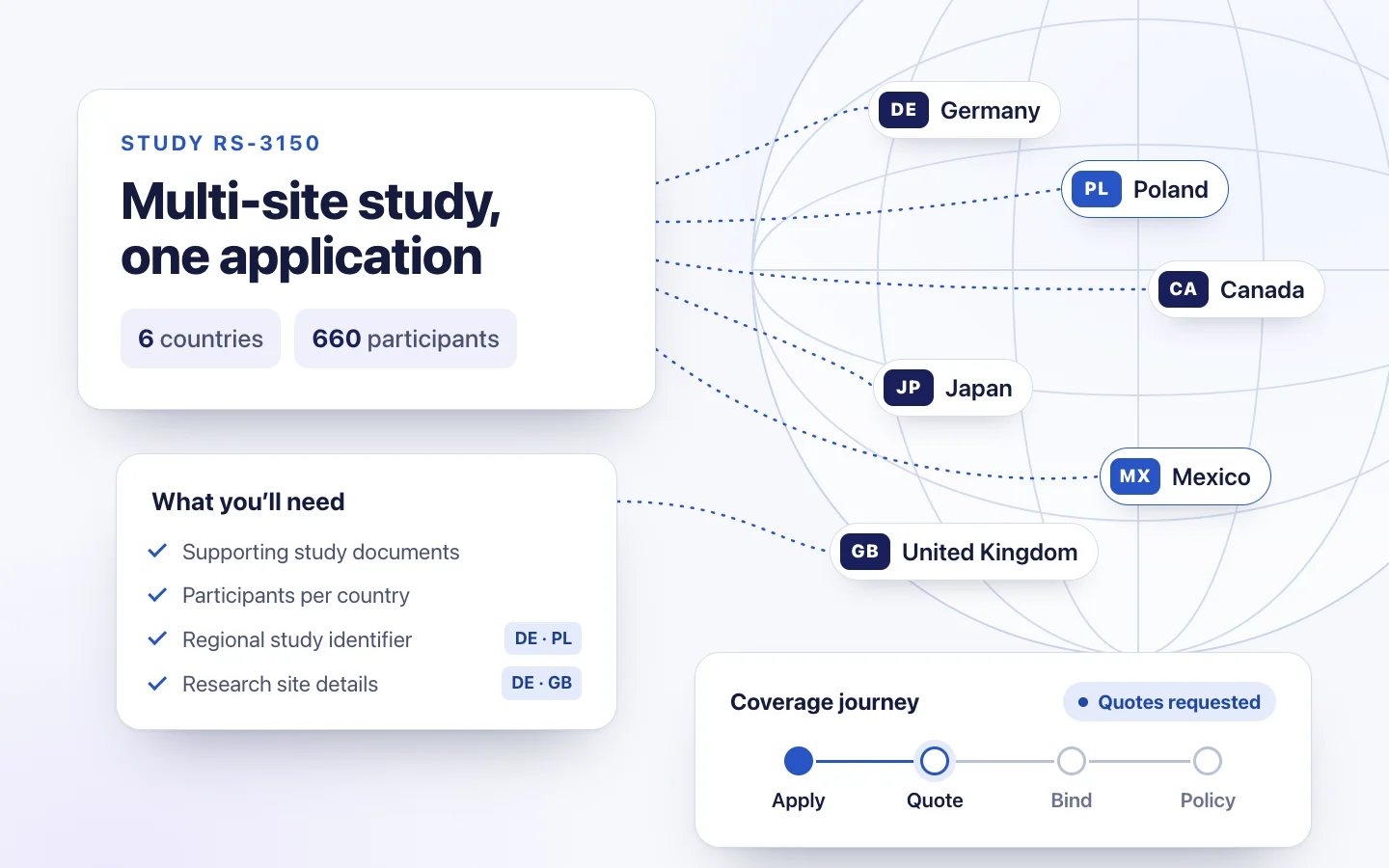
One study, many countries: a study card for a multi-site research program in 6 countries with 660 participants, linked to country chips for Germany, Poland, Canada, Japan, Mexico and the United Kingdom, a What you’ll need checklist, and a coverage journey from apply to quote, bind and policy
Role
UX / Product Design
Product
Global Research Coverage
Users
Research organizations, brokers and insurance partners
Scope
Multi-country application, quoting and servicing journey
Status
Progressed into development before I left the company

The challenge

One research program can become dozens of insurance journeys.

A research program may run in several countries, and each can add its own insurance requirements, participant information, documents and research-site details.

The legacy experience relied heavily on forms, email, documents and coordination among clients, brokers and carriers.

The design question

The challenge was not simply: How do we put an insurance application online?

How might we make a complex global coverage process understandable and actionable for an organization running research across multiple geographies?

My role

From a complex global process to a product people can use

I worked closely with Product and business stakeholders to turn a complex global insurance process into a digital product experience.

With Product and the business

  • Business rules and country requirements
  • Workflow mapping across client, broker and carriers
  • Release scope and roadmap

My design work

  • Journey and workflow design
  • Information architecture
  • Interaction design
  • The early interactive POC
  • High-fidelity UI, iterated as requirements evolved

The complexity

Three parties, many countries, one lifecycle

  • Research organizationNeeds coverage in every country where its program operates.
  • BrokerCoordinates the application and goes to the market for quotes.
  • CarrierUnderwrites each country, sets terms and issues the policy.
  1. AApply

    1. Plan the research program Client
    2. Select countries Client
    3. Understand requirements Client
    4. Submit study details Client
    5. Upload supporting documents Client
  2. BQuote

    1. Broker and carrier processing Broker · carriers
    2. Receive quotes Client
    3. Select coverage Client
  3. CBind

    1. Provide binding information Client
    2. Bind Broker · carriers
    3. Receive policy documents Client
  4. DService

    1. Manage changes and renewal Client · broker · carriers

Key insight

Quoting and binding are different information moments.

Clients don’t need to give every answer up front. Some information gets quotes; more is needed only when the client decides to bind.

Moment 1

To get quotes

What a carrier needs to price the risk.

  • Countries
  • Study details
  • Participants per country
  • Study dates
  • Supporting study documents
  • Country-specific items

Moment 2

To bind coverage

Only once the client chooses which quotes to accept.

  • Carrier-specific binding requirements
  • Confirmed organization and insured details
  • Payment arrangements, where required

Product principleAsk for the right information at the right moment.

Product decisions

Three decisions that shaped the product

  1. 01

    Start with geography

    Country selection drives what the client needs to know and provide. The system has to handle many countries at once, not behave like a single-country insurance form.

  2. 02

    Reveal requirements dynamically

    Don’t show every possible question. The countries a client selects surface only what applies, such as:

    • participant counts
    • localized study information
    • research site details
    • documents
    • country-specific requirements
  3. 03

    Design beyond Submit

    Submitting isn’t the end. The experience has to help answer:

    • What happens next?
    • Are quotes ready?
    • Is action required?
    • What’s needed to bind?
    • Where are the policy documents?
    • What happens when the program changes?

The product is a lifecycle, not a form.

Key design moments

Four moments that move the story forward

Concept reconstructions with Northstar branding and sample data, not the final product UI. Country rules are illustrative, not regulatory guidance; the real product, client and partner details stay confidential.

A

Country selection and “what you’ll need”

Problem
In the existing process, it was hard to know what each country would require until an application was well under way.
Decision
Start with country selection. Then show one checklist of what every application needs, and a table of the extra items specific countries add.
Why
Clients can gather documents and details before they invest time in the form, and the scope of a multi-country application is clear from the start.
Concept reconstruction · sample data · illustrative country rules. Locations step: six selected locations listed as rows, beside a panel of what every location needs and the extra items only some locations need, grouped by item: a localized study title, a regional study identifier, research site details or local representative details, each with the locations that ask for it.
B

Study details, country by country

Problem
Participant counts and study dates differ by country, so every added country multiplied the data entry.
Decision
Capture the study details once, then give each selected country its own row, with dates pre-filled from the general details so the client only checks or adjusts them.
Why
Less repeated typing, and each country’s numbers stay explicit, which is what carriers price.
Concept reconstruction · sample data. Participants step: one row per location with the participant count first and the study dates prefilled from the general details; two locations still need a participant count, so Next is not available yet.
C

Review, then hand off

Problem
Submitting is the moment the work leaves the client and moves to the broker and carriers, so mistakes get expensive to fix later.
Decision
A review page grouped the way the application was built, with a way to change every group. Submitting gives an application ID, a PDF copy and a contact.
Why
Clients can check a dense, multi-country application in one place and leave with a record of exactly what was sent.
Concept reconstruction · sample data. Check and submit: the application summarized in the order it was entered, locations, organization, contact, study and documents, each with a Change link, beside a Ready to send panel with the totals, the Submit application button and a link to save and finish later.
D

Save, exit and resume

Problem
An application draws on information from colleagues and research sites, so it may not be finished in one sitting.
Decision
Save and exit on every step, a warning before the session times out, and an offer to resume on the same step at the next sign-in.
Why
The application fits how research teams actually gather information, instead of forcing one long session.
Concept reconstruction · sample data. Save for later: a sheet rises over the general details step, saying the answers are kept as a draft and the client comes back to the same step at the next sign-in, with Keep going and Save draft.
Early concept prototype

Making the workflow tangible early

Before the experience was fully defined, I built an interactive POC to make the journey tangible for stakeholders and expose questions about information requirements, country logic and flow. This version keeps its workflow and reasoning with a new interface and sample data.

Explore Concept (opens in a new tab) Works on desktop and phone

Outcome

What the work established

  • Moved a fragmented insurance application process toward a structured digital experience.
  • Created a clearer path through country-specific requirements.
  • Connected application design to the broader quoting, binding and servicing journey.
  • Established a foundation for greater client self-service.

No launch metrics: the product was still in development when I left the company.

View the deep dive