The problem
Ten admins were assigning expensive design-tool seats by hand, with no shared rules, no cost tracking and nobody removing inactive seats. Requests arrived by chat, and approving was one click with no availability or cost on screen.
Venu Mathukumalli · 813.600.8927 · Venu.Mathukumalli@gmail.com · linkedin.com/in/venumathukumalli
Case study 02 Quick peek 2 min read
Internal enterprise tool An IT app employees use inside the company
Streamline Figma seat management. Employees request a seat in a secure portal and track its status. In the middle, an AI agent reviews each ticket and suggests, asks or acts within limits admins control, so people only review what needs them. Stronger governance, clearer communication.
The problem
Ten admins were assigning expensive design-tool seats by hand, with no shared rules, no cost tracking and nobody removing inactive seats. Requests arrived by chat, and approving was one click with no availability or cost on screen.
The approach
From the admins' own conversations and the vendor console I found six recurring failures, then designed one portal: request with the price on screen, track a ticket, triage, reclaim idle seats, and see it all in Insights.
Then I designed an AI agent on top. It reads a person’s activity, credit use, department spend and project type, asks only what is missing, and follows one mental model: Suggest, Ask, Act. Admins set how far it may go, and every decision can be overridden.
The centerpiece screen Agentic AI
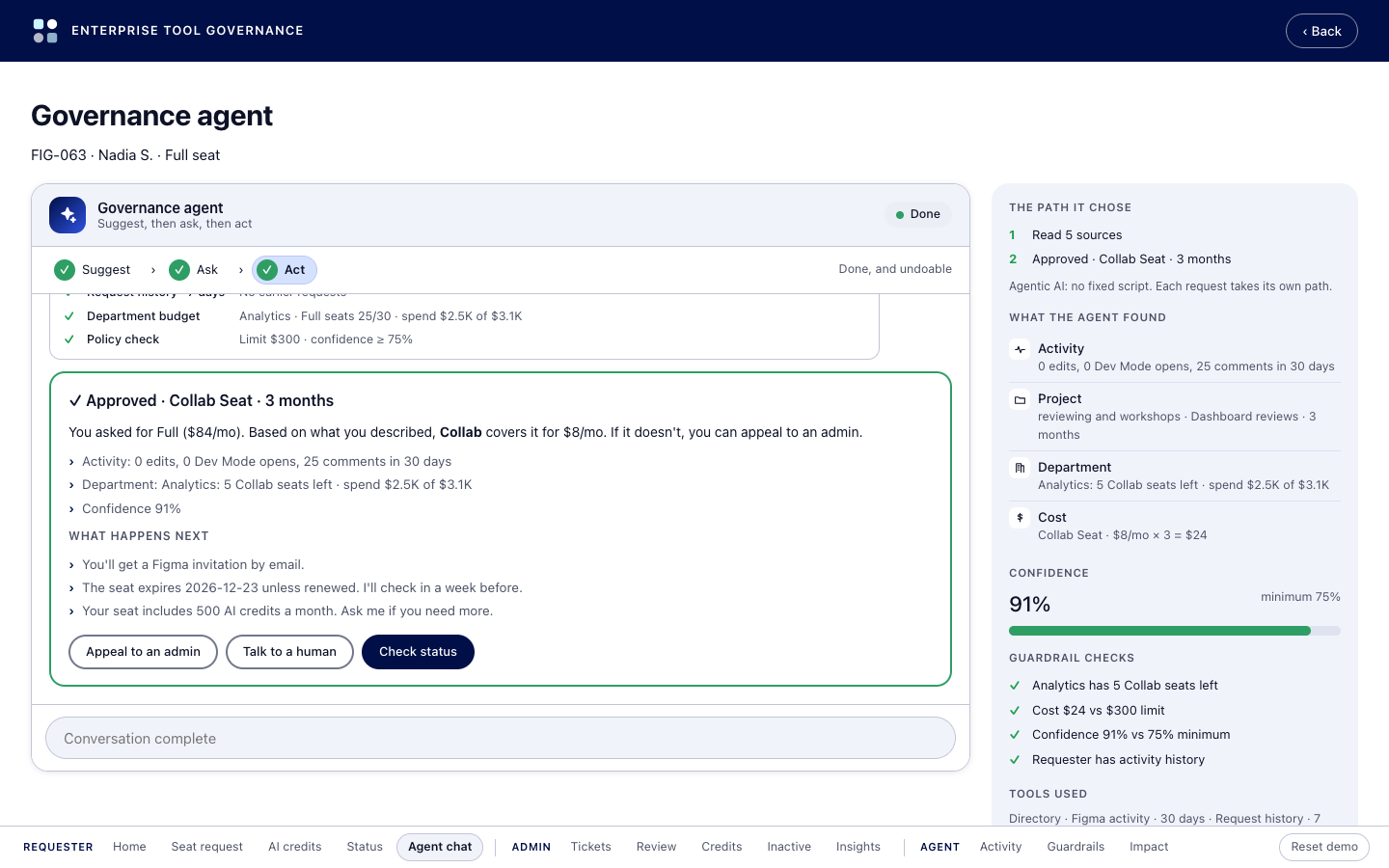
A requester asks for a Full seat. Requesters can watch the agent review and comment on their ticket, approves the cheaper Collab seat within its limits, and shows its work. Appeal and “Talk to a human” are one click away.
Outcomes, business impact & learnings
What I delivered
Modeled, not measured
What I took from it
A proof of concept for hand-off to IT, not built or tested with admins. The agent is a rules-based stand-in for a language model, and all figures and names are synthetic.
Want the full walkthrough? All fourteen screens, the agent’s guardrails, the operating model and a clickable prototype with test scenarios are in the deep dive on my portfolio site.
All fourteen screens, the agent’s guardrails and escape routes, and a prototype with scenarios you can test.